
Using data from a mobile phone survey to ask about people’s knowledge of the existence and purpose of the 2014 Swacch Bharat Mission (SBM), India’s high-profile program to tackle open defecation, we find that, at the time of the survey (between 2016 and 2018), no more than one-third of adults in any state are aware that the SBM intends to promote toilet and latrine use. This study has been published in Waterlines.
Hi, I’m Payal Hathi.
I am a sociologist and demographer, and a PhD candidate in Sociology and Demography at the University of California, Berkeley.
About
My research is on gender and the demographic measurement of mortality and fertility. It focuses on how social inequality impacts health outcomes, how patriarchy shapes demographic statistics, and methodological improvements in measuring late pregnancy losses, or stillbirths. I am trained in quantitative and demographic methods, and also use qualitative methods in my work.
In 2021, my paper published in the Proceedings of the National Academy of Sciences won PAA's Dorothy S. Thomas Award for the best graduate student paper on the interrelationships among social, economic, and demographic variables. My other research has been published in Demography, in Contraception, and in several other journals, including in Economic and Political Weekly, a leading journal of policy and social science in India.
Videos
In 2020, I spoke about how data collection using face-to-face surveys has faced a roadblock in the wake of restricted mobility and social distancing guidelines to contain the spread of Covid-19. In this video, my colleagues and I describe our experience of conducting a mobile phone survey about social attitudes, discrimination, and public opinion, which has been carried out in seven states and cities in India since 2016.
Latest Research
Assessing public awareness and use of medical abortion via mobile phone survey in India
This study demonstrates that respondents in India are willing to answer abortion-related questions via mobile phone survey. We find that in Bihar and Maharashtra, less than one-third of respondents said they had heard of medical abortion, and awareness was positively associated with education and women’s status in the household. Reported use of abortion medication was low. This study has been published in Contraception.
Caste prejudice and infection why a dangerous lack of hygiene persists in government hospitals
Through interviews and observations at public hospitals in Uttar Pradesh, Madhya Pradesh, and Bihar, this study finds that deep caste prejudice against cleaners prevents the professionalization of their work, leaving them overburdened and under-equipped to maintain standards of hygiene. This study has been published in Economic and Political Weekly.
Can collective action strategies motivate behavior change to reduce open defecation in rural India?
Using quantitative and qualitative analyses, this study finds that strict social hierarchies that continue to govern daily interactions in rural Indian life today obstruct the spirit of cooperation upon common community-led approaches to reducing open defecation rely. Additionally, caste-based notions of purity and pollution make the simple latrines used all over the developing world unattractive to rural Indians. This paper has been published in Waterlines.
Latest Media
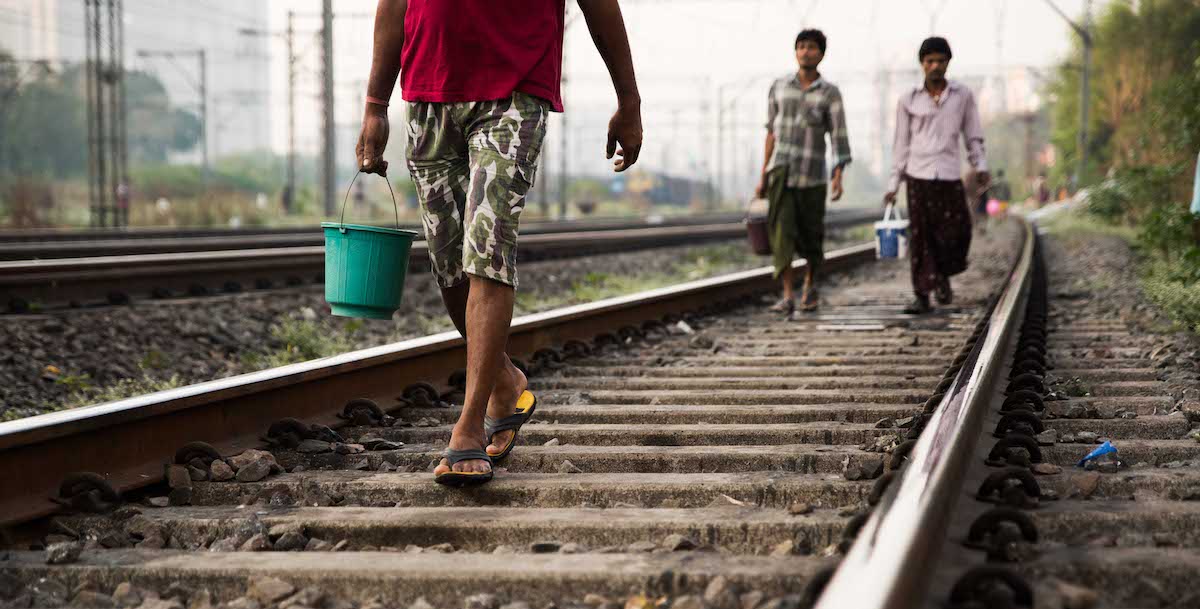
Coercion, construction, and ‘ODF paper pe’: Swachh Bharat according to local officials | India Forum
The Swachh Bharat Mission has turned out to be a top-down programme in which villagers are often coerced into building latrines, with relatively little focus on latrine use.
Our Essential Workers Need Essential Care | EPW
Through personal interviews of healthcare workers in India, the state of front-line workers in dealing with Covid-19 in the country is discussed. Lack of personal protective equipment and beds as well as the caste system that operates when it comes to doing cleaning work in the hospitals aggravates the already debilitating condition of healthcare personnel. Despite being the most important stakeholders of health in rural areas, the accredited social health activists are leading a life full of struggles.
Why we still need to measure open defecation in rural India | Ideas for India
On October 2, the government will host the UN Secretary General and other international delegates at the Mahatma Gandhi International Sanitation Convention, to celebrate India’s progress on ending open defecation. While the recently released National Annual Rural Sanitation Survey data seem to show that open defecation is being eliminated from rural India, this conclusion is unfortunately premature.
Protecting health workers: Protective gear is not enough, infection control practices are critical
The practices of health workers will have a major impact on the trajectory of the COVID-19 pandemic in India. The government should be as focused on providing supplies and training to small-scale providers as to major hospitals. We must train and protect our health workers so that they can care for us.